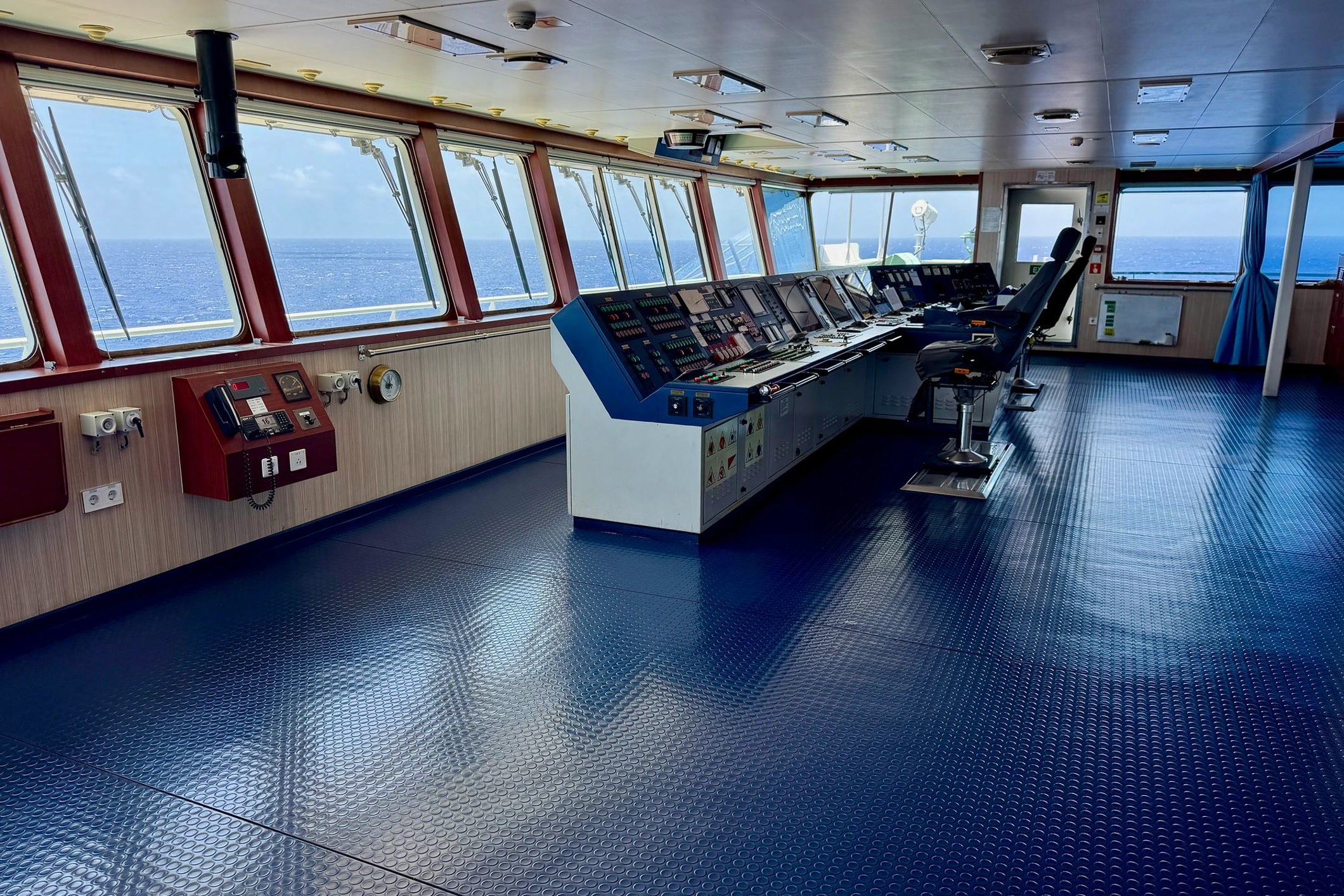

Bridge windows that fog from the first cold current are a fixture of life at sea. Wipe them down and the haze is back in minutes; salt film outside, condensation inside, and the watch turns into a fight with a rag. Most operators treat it as inevitable — one more thing the sea takes. It is not. It is a glazing problem, and it has a glazing solution.
Why a ship is the hardest place to keep glass dry
A building faces its cold season for a few months a year. A vessel carries its cold season with it: seawater in the 5–15 °C range on one side of the hull, a heated and occupied cabin on the other, for as long as the route demands.
Then add the humidity sources a building never carries in the same concentration. Galleys boil and steam through every meal service. Showers run. Crew respiration adds moisture to a sealed living space around the clock. Wet gear dries in the passageway. Indoor relative humidity climbs fast aboard, and every point of it pushes the dew point higher.
Condensation lands on the coldest large surface in the cabin — and aboard, that is the glass. Wheelhouse windows, saloon glazing, pilothouse doors: they are large, they face the water, and they sit close to the cooled exterior. On the bridge the result is more than a nuisance. A watchkeeper looks through that glass. Wiping leaves salt-haze streaks that scatter light at night, and condensation on the wrong night is a navigation hazard, not a housekeeping chore.
The same physics that keeps a house window dry
The rule that governs condensation is identical ashore and afloat: glass fogs when its inner surface falls below the dew point of the surrounding air. Our guide to how vacuum-insulated glass stops window condensation works through the numbers for a house at a 70 °F indoor / 0 °F outdoor design condition — single pane, double pane, triple pane, and vacuum glazing, inner-surface temperature by inner-surface temperature.
What changes aboard is the margin. In a house at moderate humidity there is a comfortable gap between room air and dew point; in a working cabin running 60–70% relative humidity, that gap nearly closes. A window that survives a building’s winter can fog on a ship in autumn, because the air is wetter and the glass — chilled by the sea on its far side — runs colder than any building window ever will.
That is precisely the regime where the cavity design matters. With almost no gas inside the gap to carry heat across, a vacuum insulated glass unit holds its inner lite much closer to cabin temperature. At the worked 70 °F / 0 °F condition above, the vacuum build reaches roughly 63 °F at the inner surface — the warmest of any glazing type in the comparison, and the most margin against any dew point a lived-in space produces.
Weight: half the glass mass, the same performance class
Glass weighs about 2.5 kg for every square metre, per millimetre of thickness. A 6.3 mm THERMGLASS vacuum unit — two 3 mm lites and a hairline evacuated gap between them — comes to roughly 15 kg/m², close to the single pane it replaces.
A triple-glazed unit built for comparable thermal performance carries roughly twice the glass mass before you count spacers, sealant, and the deeper framing that a 30-plus-millimetre build-up demands. Aboard, that difference lands where it hurts: high in the superstructure, where every kilogram removed lowers the centre of gravity and gives the stability calculation margin back instead of spending it.
Depth: refits without re-cutting the boat
Marine openings are among the tightest in the glazing industry. Frames are engineered around the glass fitted at launch, and wheelhouse structure is not somewhere an owner wants to start cutting.
Because the frit edge seal is fused and flush — and the unit is portless, with no pump-out stub — the overall depth equals the glass stack itself: 6.3, 8.3, or 10.3 mm. A 6.3 mm vacuum unit drops into a rebate cut for a single pane. No perimeter ribbon, no hidden build-up to discover during installation.
One practical note when comparing vendors: some welded-edge VIG designs add measurable perimeter height beyond the glass stack. Always verify the build-up against your opening — the flush frit seal is what lets the thin build drop straight in. Where an opening allows more depth and the project wants maximum performance, a hybrid unit pairs the vacuum pane with a conventional IGU cavity at roughly 20.3–26 mm overall.
Fuel: the HVAC load you generate yourself
A building draws its heating and cooling from a grid. A vessel generates its own power, and every watt of cabin conditioning is fuel burned at sea.
The marine ROI engine on this site is built around that reality: it assumes $0.35 per kWh for onboard generated electricity — the real cost of running a diesel-generator plant — and 0.60 kg of CO₂ per kWh as a blended figure across generator operation and shore power, over a 20-year analysis horizon. Against those numbers, glazing that cuts the heating and cooling load is not a comfort upgrade. It is a fuel-line item, and the engine prices it like one.
The centre-of-glass figures behind the engine are the same ones published across this site: 0.46 W/m²·K on the standard build (integral low-E included) and 0.25 W/m²·K for the hybrid VIG-plus-cavity assembly. Those values are calculation-derived using the published EN 673 / ISO 10292 methodology — NFRC and EN type-approval testing is in progress, and certified test data supersedes the calculated figures when it is available.
Noise: the quiet dividend
The evacuated gap that stops conduction also interrupts airborne sound. Rain on the overhead glass, spray and wash across the front, the hum that travels through a superstructure — all of it arrives quieter through a vacuum cavity than through a single lite. For a bridge team standing a long watch, and for guests a deck below, it is a difference you notice without being able to name it. For a full breakdown of STC and Rw design-stage estimates — and how the vacuum cavity suppresses the mass-air-mass resonance that weakens conventional IGUs — see Vacuum Glass Acoustic Performance: STC, Rw, and What the Numbers Mean.
Specifying for the salt environment
On the standalone unit, the edge seal is fused glass — a glass-to-glass frit joint rather than an organic sealant line, with nothing for a salt-laden service environment to attack the way it attacks conventional sealants over a service life. The flush edge also means nothing protrudes past the glass face: no raised ribbon to catch hose ends, cleaning gear, or canvas.
Where a hybrid unit is specified, the perimeter follows standard warm-edge practice on top of the vacuum cavity — the same warm-edge treatment that keeps the edge zone of any high-performance unit above the condensation risk line.
The bottom line
Cold water on one side, wet air on the other, and a watch that needs to see out: marine glazing is a condensation, weight, depth, and fuel problem — usually all four at once. Vacuum insulated glass answers them in a single specification: a warm inner surface that stays above the dew point, roughly half the glass mass of the triple-glazed alternative, a 6.3–10.3 mm build that fits the rebate the vessel launched with, and an HVAC load reduction priced at sea-generated rates.
See the marine market page for the application overview, or run your route and rates through the marine ROI calculator to put fuel and CO₂ numbers on your own project.
Keep reading
The physics above plays out in the modeled refit: see the 55 m yacht wheelhouse scenario for modeled surface-temperature, weight, and HVAC-fuel outcomes at sea-generated rates. For EU and UK specification — EN 673, polar class, EUR pricing — see vacuum glass for EU and UK marine projects.