
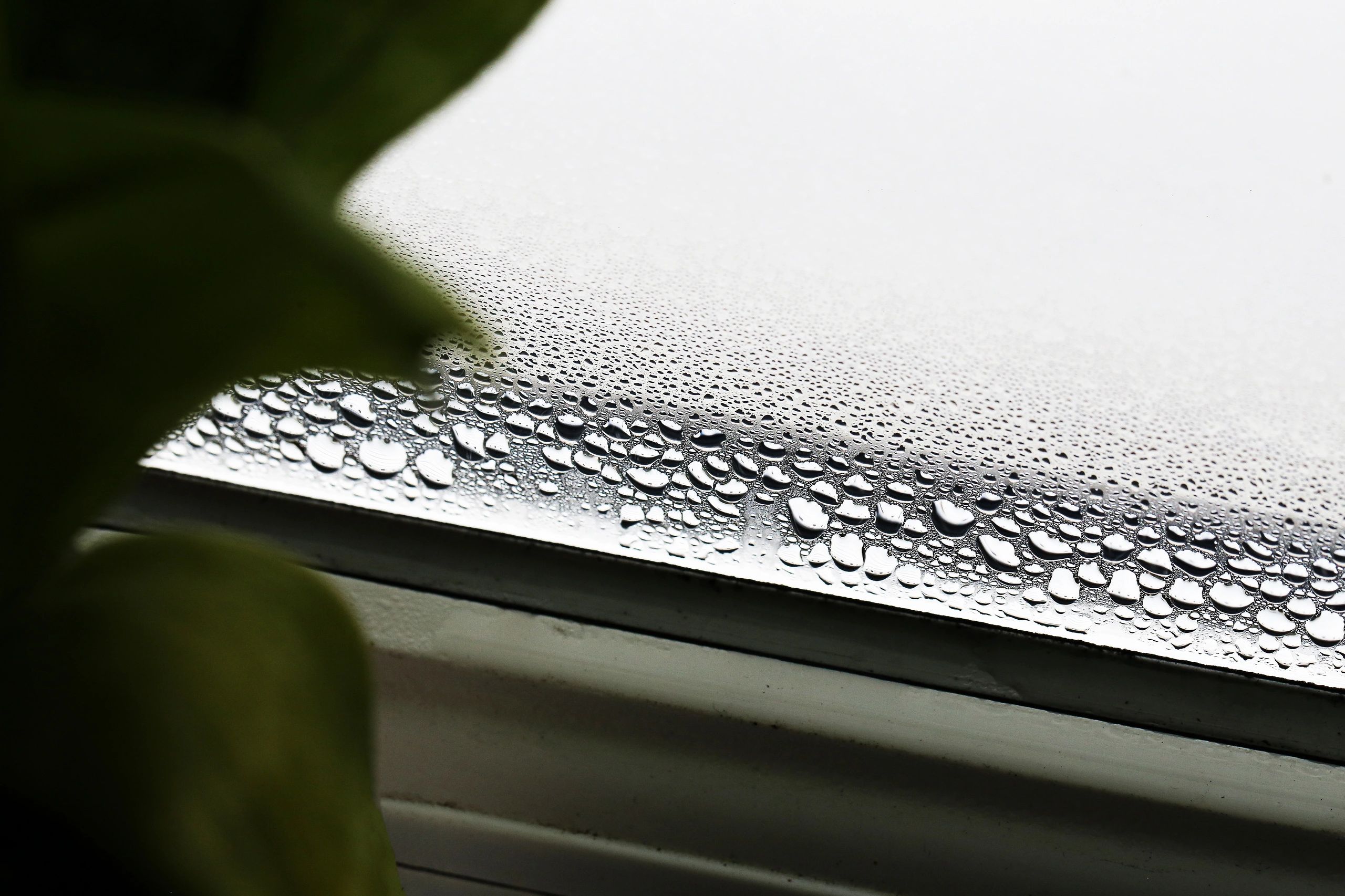
Every winter the same complaint comes back: windows that stream with water, sills that need wiping every morning, paint that never quite dries at the frame. Most people are told to run a dehumidifier or open a window. That treats the symptom.
Condensation on a window is not primarily a humidity problem. It is a surface-temperature problem — and that reframe is exactly why vacuum-insulated glazing behaves so differently from every glass you have owned before.
The physics: condensation is a surface-temperature problem
Air holds a limited amount of water vapor, and that capacity collapses as air cools. The temperature at which the air in a room becomes saturated — the point where vapor starts turning back into liquid — is the dew point.
Condensation appears on the coldest surface in the room. In winter, that is almost always the inner face of your window. If the glass surface is colder than the room's dew point, moisture from the air condenses on it. If the surface stays above the dew point, the same air, with the same humidity, leaves no water behind.
So the question that actually matters is not "how humid is my house?" It is:
How warm is the inner surface of the glass when it is cold outside?
That single number — interior surface temperature — separates windows that sweat from windows that stay dry.
How cold does glass actually get?
You can estimate the inner-surface temperature of any window with a simplified steady-state model: the surface sits between room temperature and outdoor temperature, pulled toward the outdoors in proportion to how poorly the window insulates.
Here is a worked example. Indoor air at 70°F, outdoor air at 0°F — a 70-degree difference, which is a real design condition in much of the northern US. Using a typical interior air-film coefficient of roughly 1.4 Btu/h·ft²·°F, the inner surface lands at approximately:
- Single pane (U ≈ 1.1): about 15°F — colder than a freezer. Water condenses freely, and frost forms on the coldest nights.
- Standard double pane (U ≈ 0.30): about 55°F — dry in the center at moderate humidity, but close to the dew point whenever indoor humidity climbs.
- Triple pane (U ≈ 0.20): about 60°F — a real improvement, with more margin.
- Vacuum-insulated glazing (U ≈ 0.13–0.15): about 63°F — the warmest inner surface of any of these, by a clear margin.
Now set those surface temperatures against dew points for 70°F room air:
- 30% relative humidity → dew point ≈ 37°F
- 40% relative humidity → dew point ≈ 45°F
- 50% relative humidity → dew point ≈ 50°F
- 60% relative humidity → dew point ≈ 55°F
Read the two lists together and the pattern is immediate. A single pane sits far below every dew point a lived-in house produces, so it sweats from the first cold snap. A standard double pane only clears the dew point at moderate humidity — raise the room to 60% RH on a cold night and the center of the glass is already at the threshold. Vacuum glazing keeps its inner surface roughly 8–26 degrees above the dew points in that list — about 8°F of margin even at the highest (55°F, a 70°F room at 60% RH) — which is why the glass stays dry in conditions that fill other windows with water.
These are center-of-glass estimates, and real rooms are messier than the model — curtains trap a microclimate of humid air against the glass, cooking and showering spike indoor humidity for hours, and surface films change the numbers slightly. But the ranking never changes: the better the window insulates, the warmer its inner surface, the more condensation margin you own. For the head-to-head with triple glazing on this exact margin, plus sound and payback, see VIG vs triple glazing: sound, condensation, payback.
Why double and triple panes still sweat at the edges
If you live with a double- or triple-pane window, you already know condensation does not start in the middle of the glass. It starts in a band a couple of inches wide around the perimeter.
That band is the edge-of-glass zone, where the spacer, the sealant line, and the frame create local thermal bridges that drag the surface temperature down below the center-of-glass value. The insulated-glass-unit industry's answer to this has been the warm-edge spacer — a spacer design with lower thermal conductivity that keeps the perimeter band closer to the center-of-glass temperature. Every incremental improvement in edge warmth directly raises the coldest line of the window above the dew point for more hours of the winter.
This matters because the edge zone is exactly where the damage shows up first: staining on the sill, peeling paint at the frame, and — in the worst cases — moisture working into the frame cavity where you cannot see it.
Where vacuum glazing changes the math
Vacuum-insulated glazing attacks the problem from a different direction. Instead of managing convection and conduction in a thick gas gap, it removes nearly all of the gas. Two panes — in our configurations as thin as 6.3 mm standalone — are separated by a sub-millimeter vacuum gap held under a peripheral seal, with microscopic pillars keeping the faces apart.
The vacuum gap does two things that matter for condensation:
- It slashes the U-value. With no gas in the gap, there is no convection or conduction across it, so heat has almost no path from the warm room to the cold outdoors through the glass. A low U-value is not just an energy metric — as the worked example above shows, it is the direct driver of interior surface temperature.
- It keeps the structure thin. Because the insulating gap is fractions of a millimeter instead of a half-inch, the whole unit fits slim sightlines and — in our hybrid configuration — retrofits into existing sash and frame geometries that a triple-pane unit physically cannot occupy. The condensation performance arrives without the dimensional penalty.
At the perimeter, our hybrid units pair the vacuum cavity with a warm-edge seal design, so the coldest zone of the window gets the same treatment the industry has converged on — applied to a glass package whose center-of-glass performance starts from a much warmer baseline.
The combined effect is simple: on the coldest design night your building sees, the inner surface of a vacuum-insulated window stays well above the dew point of a normally occupied room. The glass stops being the cold surface that pulls moisture out of the air.
The same physics, minus forty degrees: cold storage
Walk the same logic into a supermarket and the stakes get higher. A freezer aisle is a warm, humid space sitting against a door package whose other face is at −20°F or colder. The aisle-side surface of a conventional freezer door glass is so cold that water vapor in the aisle air deposits as frost, not droplets — and frosted doors get scraped, heated, and re-heated, burning energy around the clock.
Vacuum glazing flips that surface temperature. With a U-value a fraction of a conventional freezer-door glass package's, the aisle-side surface stays above the frost point in air conditions that blanket ordinary doors in ice. Same physics, colder box, bigger payoff — and it is one of the reasons vacuum glass has moved fastest in refrigeration and cold-storage applications.
What this means for your building
If you are fighting window condensation today, the honest sequence is:
- Measure, don't guess. A cheap digital hygrometer tells you your indoor RH; a $15 infrared thermometer pointed at the glass on a cold morning tells you your actual surface temperature. Condensation happens wherever the surface reads below the dew point — no mysterious "bad luck" required.
- Manage humidity where you can. Building-science guidance for deep-winter indoor RH commonly lands in the 25–40% band — low enough to protect frames and sheathing, high enough for comfort. Ventilation after showers and while cooking does more than any dehumidifier cycle.
- Fix the surface temperature where it counts. Humidity management lowers the dew point; better glazing raises the surface. They attack the same gap from both sides — but only one of them is permanent. A window whose inner surface stays above the dew point by design does not need watching, wiping, or a machine running next to it.
That last point is the difference vacuum glazing buys. The dew point of your room is set by how you live. The surface temperature of your glass is set by what you install. One of those is a daily negotiation; the other is an engineering decision you make once.
The takeaway
Condensation is not a humidity failure — it is your window announcing, in water, exactly how cold its inner surface runs. Vacuum-insulated glazing raises that surface temperature higher than any comparably thin glazing available, holds the margin through deep-winter design conditions, and keeps the edge zone warm without inflating the unit's thickness.
Dry windows in January are not a luxury. They are what a glass package with a warm inner surface looks like — and the physics behind it is straightforward enough to check with a hygrometer and an infrared thermometer this week.
If you want to see what the numbers look like for your own building — your climate, your glass, your geometry — the THERMGLASS team runs project-specific thermal and condensation analyses alongside the glazing configurator. Bring us the coldest design condition your building faces, and we will show you where the surface temperature lands.
Keep reading
For quick answers beyond the worked example above — how vacuum glazing compares with double glazing, typical U-values, and whether it stops condensation — see the vacuum glass FAQ.
Keep reading
The full walkthrough, including the worked surface-temperature comparison across glazing types, is available as the condensation control guide. For why pane count decides the outcome, see why vacuum glass stays drier than triple pane.