
Therm Glass Group LLC
The Warm-Edge Vacuum Advantage.
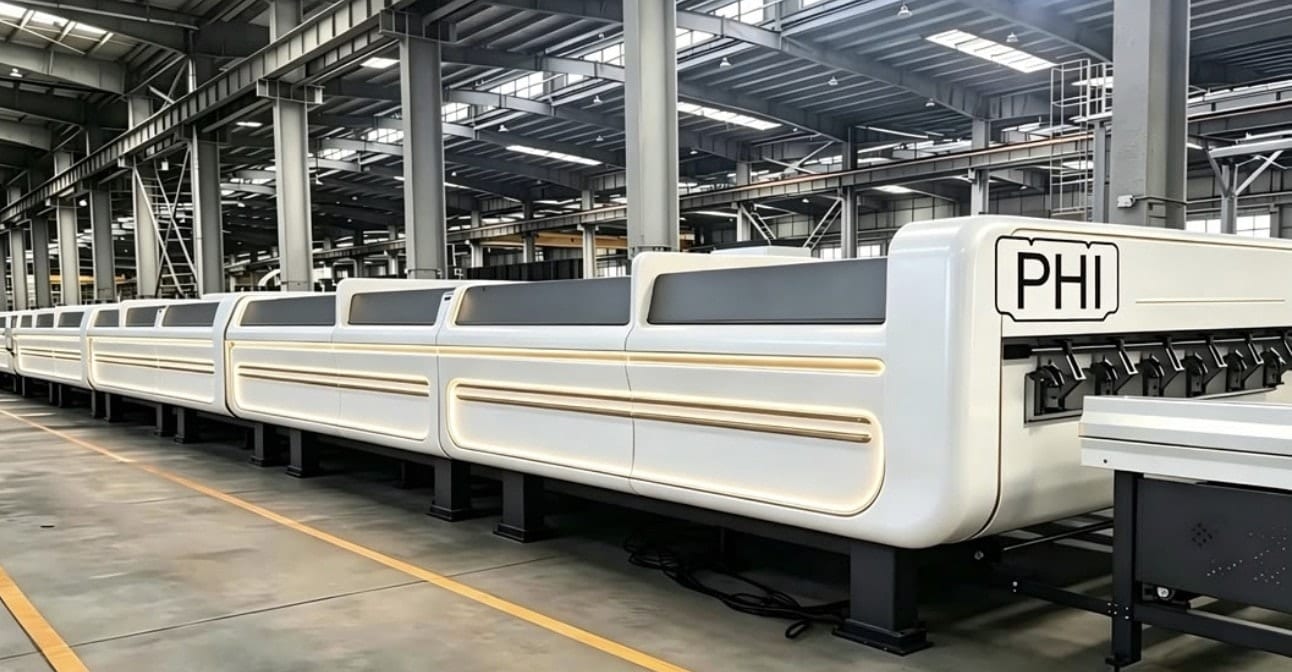
3rd-generation Warm-Edge Vacuum Insulating Glass (VIG) — produced on an advanced continuous VIG production line, operated by our manufacturing partner.
0.46 W/m²·K
COG U-Value (center-of-glass)
6.3–26 mm
Unit Profile (3 mm lites to full hybrid)
~50%
Weight Reduction vs. 24 mm Triple-Pane (6.3 mm unit)
STC 35–45
Acoustic Range (standalone–hybrid)
The Technology
Vacuum. Warm Edge. Continuous Process.
THERMGLASS is produced on an advanced continuous VIG production line — evacuated and sealed inside a vacuum chamber with no ports, no metal bands, and no thermal bridges. The result is a portless, hermetically sealed vacuum unit with no structural weak point and no long-term seal degradation.
Center-of-glass U-values of 0.46 W/m²K (0.081 Btu/h·ft²·°F) in standalone units from 6.3 mm (3 mm lites) to 10.3 mm (5 mm lites) — the flush glass-frit seal keeps unit depth equal to the glass stack — fitting historic retrofits, narrow sash frames, and modern curtain wall systems without structural redesign.
ROI & ENERGY PAYBACK
See the numbers for your project.
Built on the simplified ASHRAE steady-state conduction model — the same method engineers use for quick glazing comparisons. Enter your project details and the savings, payback, and CO₂ figures update instantly as you type.
Project Inputs
ISO 10077-1 estimate: ~0.13 (standalone) · ~0.10 (hybrid) Btu/h·ft²·°F
This rate covers cooling — air conditioners run on electricity. Heating savings use the heating-fuel rate instead: natural gas at $1.35/therm by default, roughly 4.6¢ per kWh of heat. Change the fuel in the Full analysis.
Incremental cost: $9,000 · Baseline U: 1.10 Btu/h·ft²·°F
Simple Payback
5.7 yrs
Within typical ownership cycle
Annual savings
$1.6k
Energy saved/yr
32.0 MWh
NPV (25 yr)
$19.8k
CO₂ avoided/yr
6.0 t CO₂
BIPV + WARM-EDGE VIG — ENERGY AND CARBON IMPACT
Cut HVAC energy and carbon — generate solar in the same lite.
ASHRAE + IEC 61853 dual-stream model — see the HVAC energy your facade saves and the CO₂ it avoids, with built-in photovoltaic (BIPV) generation calculated alongside.
Project Inputs
CO₂ Avoided / Year
2.3 t CO₂
HVAC energy saved plus on-facade PV displacing grid electricity
Thermal savings/yr
$416
PV revenue/yr
$381
Total savings/yr
$796
HVAC energy saved/yr
6.5 MWh
Combined payback: 45.8 yr
A long-cycle infrastructure decision — BIPV facades are specified for the life of the building, not a short payback window. Set your own tariff, area, and premiums above for project-specific numbers.
Annual PV yield: 2.4 MWh
POA irradiance 780 kWh/m²/yr · IEC 61853-3 / PVGIS TMY
Markets
Five Markets. One Breakthrough.
Architectural
R-12+ center-of-glass thermal performance without adding structural weight or deep frames. Fits historic retrofits, narrow sash frames, and modern lightweight curtain walls — including 4-sided structural silicone glazing.
Refrigeration
COG U-factor 0.081 Btu/h·ft²·°F (R-12.3) standalone, 0.039 Btu/h·ft²·°F (R-25.6) hybrid. Keeps door glass above the dew point under typical operating conditions without anti-sweat heater wiring, reduces compressor load, and supports OEM cabinet compliance with NSF/ANSI 7 and ASHRAE 90.1.
Construction Vehicles
Extreme thermal and acoustic performance for construction vehicle cabs and off-highway equipment. Passive defogging, STC 35–39 (standalone) to STC 41–45 (hybrid) noise reduction, and structural integrity under vibration and load.
RV & Mobile
Passive defogging, 50% weight savings vs. triple-pane, and SHGC control for desert and cold-climate travel. Fits most existing RV aluminum and vinyl frame rebates. ANSI Z26.1 / FMVSS 205 compatible substrates.
Marine & Offshore
ISO 10077-1 whole-unit U-values, Rw 38–42 dB acoustics, and marine-premium edge seal for superyachts, commercial vessels, ferries, and offshore platforms. DNV and Lloyd's Register documentation support in development.
EU/UK Marine
Specify VIG for EU/UK-flagged vessels in metric units. EN 673 COG U-values, EN ISO 10077-1 whole-unit Uw, IMO A.1116(30) fire advisory, Polar Code thermal check, and EUR pricing.
Why THERMGLASS
Four Reasons Specifiers Choose VIG
Portless Continuous Process
No exhaust tube, no port patch, no seal degradation over time. The vacuum cavity is established and sealed inside a vacuum chamber — the only process that eliminates the port entirely.
True Warm-Edge Performance
Warm-edge composite pillar grid replaces the spacer bar entirely. No continuous metal path from lite to lite — no thermal bridge, no edge condensation, no performance gradient from center to perimeter.
Slim Profile, Maximum Retrofit Fit
Standalone units are 6.3 mm (3 mm lites), 8.3 mm (4 mm lites), or 10.3 mm (5 mm lites) overall — the portless glass-frit edge seal is flush, so unit depth equals the glass stack. Hybrid builds reach ≈20.3–26 mm overall to fit standard IGU frames. No structural redesign, no new frame system — drop-in performance upgrade.
Multi-Market Certification Path
Architectural (Passive House, LEED, IECC), refrigeration (supports NSF/ANSI 7 OEM cabinet compliance, ASHRAE 90.1), vehicle (ANSI Z26.1/ECE R43), and marine (DNV, IMO advisory) — one glass platform, multiple compliance paths.

Retrofit Example
Warm-edge VIG, retrofitted in place.
This is what a warm-edge VIG retrofit looks like: the original frames stay, and the glazing is swapped in place. Standalone THERMGLASS units measure 6.3 mm (3 mm lites), 8.3 mm (4 mm lites), or 10.3 mm (5 mm lites) overall — the portless glass-frit edge seal is flush with the glass stack — so most rebates take the upgrade without structural redesign.
Center-of-glass U-value 0.46 W/m²·K replaces the thermal loss of single glazing or tired double-pane units, while cutting unit weight roughly in half versus 24 mm triple-pane — easing load on sashes, hinges, and heritage mullions. Hybrid builds reach ≈20.3–26 mm for standard IGU pockets.
- Drop-in glazing swap — verify build-up per opening against the existing rebate
- 0.46 W/m²·K center-of-glass, no continuous metal edge path
- ~50% lighter than 24 mm triple-pane at comparable performance

For Architects
The glass that fits your spec — not the other way around.
THERMGLASS VIG drops into existing frame systems with standalone units from 6.3 mm overall (3 mm lites; 8.3 mm and 10.3 mm builds available) — no frame redesign, no structural penalty. COG U-value 0.46 W/m²·K is designed to meet Passive House and ENERGY STAR thresholds, and contributes to LEED credits — in a single lite.
0.46
W/m²·K COG U-value
EN 673 centre-of-glass. Whole-unit Uw 0.73 W/m²·K (ISO 10077-1, thermally-broken frame). On the Passive House certification path.
6.3 mm
Centre-of-glass stack
Standalone unit depth 6.3 mm (3 mm lites), 8.3 mm (4 mm lites), or 10.3 mm (5 mm lites) — the portless glass-frit edge seal is flush, so unit depth equals the glass stack. Verify build-up against the existing rebate per opening.
~50%
Lighter than 24 mm triple
The 6.3 mm standalone unit is roughly half the weight of 24 mm triple-pane at comparable thermal performance — critical for heritage and high-rise facades. The 8.3 mm and 10.3 mm builds are proportionally heavier.

For Manufacturers & Investors
Own Your Factory.
The complete continuous VIG production line is available as a turnkey package — from raw glass in to finished warm-edge vacuum glass out. Own the line, produce under your own brand, and serve your market directly. Turnkey pricing available worldwide.
Explore the OpportunityFAQ
Frequently Asked Questions
Straight answers on THERMGLASS warm-edge VIG — installation, warranty, shipping, and how vacuum glass compares with double- and triple-pane glazing.
Ready to Specify?
Contact our technical team for project-specific U-factor calculations, compliance documentation, and indicative pricing.