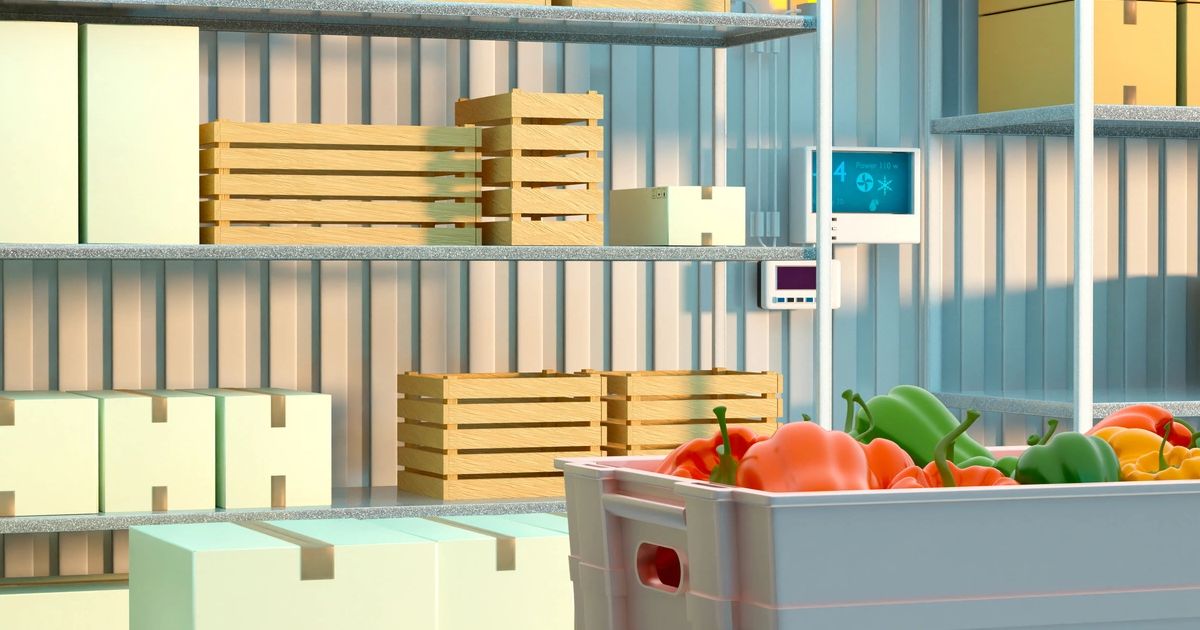
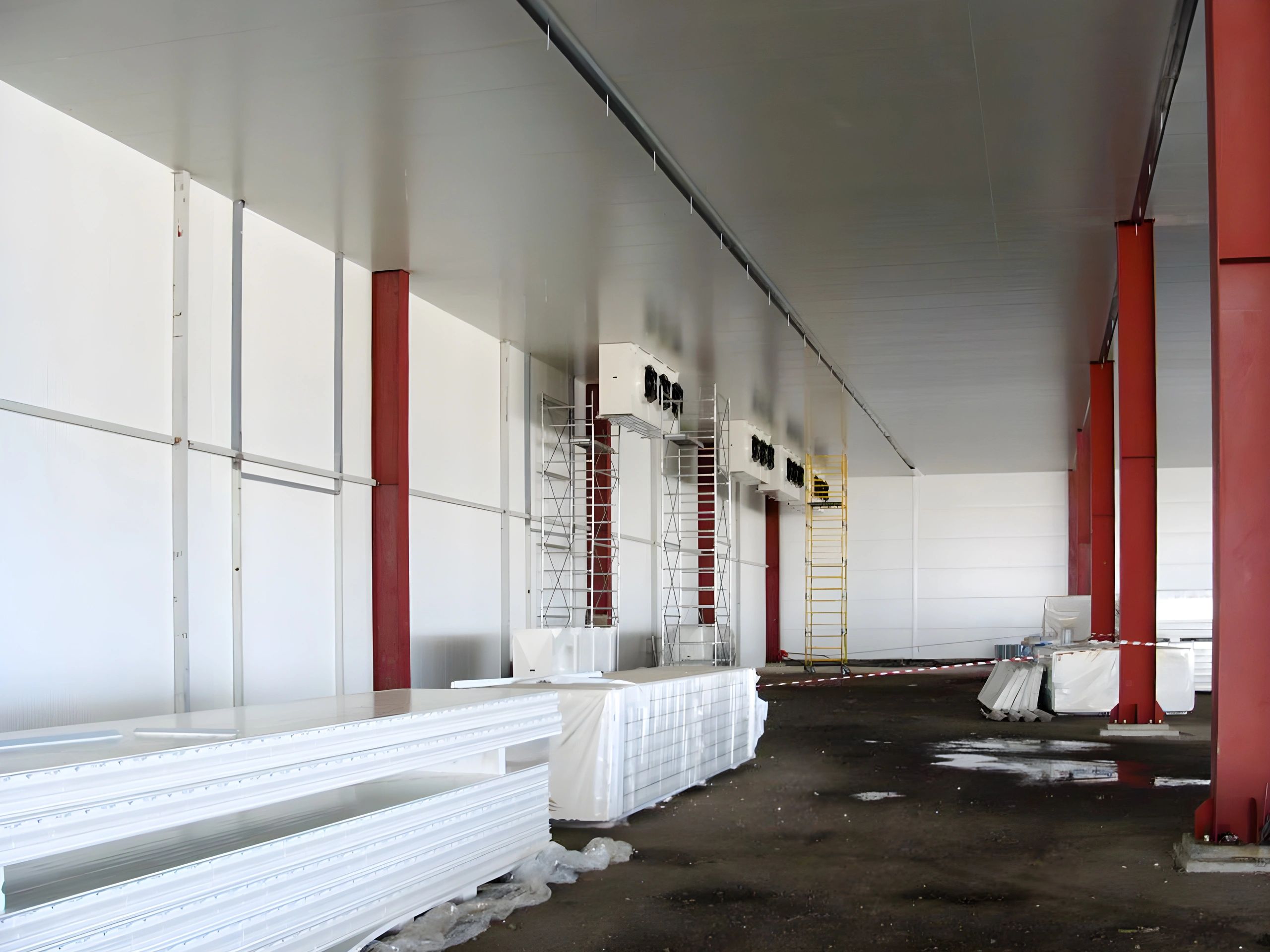
Frozen-food distribution runs on a temperature difference that never clocks out. The building envelope gets to rest on mild nights; a cold storage facility does not — the difference between a −10 °F freezer room and a 60 °F dock corridor is there at 3 a.m. on a Sunday exactly as it is at Monday noon. That is why glazing decisions deserve more attention at the facility level than their small areas suggest: every square metre of glass between temperature zones runs 8,760 hours a year, and everything it lets through has to be pumped back out by the compressors.
Where glass actually shows up in a cold facility
Cold storage is not a curtain-wall building, but it is not glass-free either. Vision panels are cut into insulated swing and sliding doors on freezer and cooler rooms, pass-through windows serve picking and staging areas, observation panels let supervisors watch operations between zones without opening a door, and control rooms and dock offices face the cold floor through conventional windows.
Individually these are small surfaces. Collectively they sit across the deepest temperature differences on the site, in continuous duty, on the one energy meter where every kilowatt-hour of heat gain is paid for twice — once as the heat itself, and again as the compressor work to remove it.
The energy math runs 24 hours a day
The conduction term is the same equation as in any building — Q = U × A ΔT × hours — but the hours term is what separates cold storage from architecture. An office facade sees its winter design condition for a fraction of the year; a freezer vision panel sees its design condition every hour of the year.
Against the clear double-pane reference the cold-storage configurator uses — 0.48 Btu/h·ft²·°F center-of-glass (≈ 2.73 W/m²·K) — the calculated center-of-glass figures from the EN 673 / ISO 10292 methodology give:
- Standalone vacuum glass: 0.46 W/m²·K (0.081 Btu/h·ft²·°F) — an 83% reduction in conductive heat gain.
- Hybrid VIG (vacuum pane plus IGU cavity): 0.25 W/m²·K (0.044 Btu/h·ft²·°F) — a 91% reduction.
Then the compressor multiplier. Heat that crosses the glass becomes refrigeration load, removed at a coefficient of performance of roughly 2 to 3. The electrical cost of a glass watt is therefore about a third to a half of a watt, around the clock — and because the duty never cycles off, the savings compound with every hour the facility runs, which is all of them.
Frost and condensation: the operating cost nobody line-items
Energy is only half the case. The other half shows up as frost.
Glass fogs and frosts when its warm-side surface falls below the dew point of the air on that side. In a cold facility the condition is close to designed in: a vision panel in a freezer door sits across a temperature difference of 70 °F or more between a −10 °F room and a loading corridor, and a conventional insulated unit runs its warm-side lite far below the ambient dew point on humid days. The result is the routine every operator recognizes — fogged panels at shift start, frost bloom overnight, morning wipe-downs, ice at door thresholds, and visibility that fails exactly when someone needs to see a forklift on the other side.
Vacuum glass attacks the mechanism instead of the symptom. With almost no gas in the cavity, there is no conduction or convection path to chill the warm-side lite, so it tracks room-side temperature instead of cold-side temperature. THERMGLASS standalone units are specified to condensation resistance of CR 77 or higher, and hybrid units to CR 89 at the configurator’s default frame assumptions — design-intent values, with certification attaching at the completed door or panel assembly rather than the glass component. At those ratings the warm-side surface holds above the dew point across normal facility conditions, and the frost cycle stops at its source rather than being scraped off every morning. Our window condensation guide works through the surface-temperature mechanics in detail.
What fits where
Standalone vacuum units come in 6.3, 8.3, and 10.3 mm depths — the portless glass-frit edge seal is fused and flush, so the unit's overall depth equals the glass stack itself. That is what makes the retrofit path easy: a vision panel originally built around double-pane IGU takes the 6.3–10.3 mm build without frame surgery once the rebate depth is confirmed.
For freezer-side applications that need the widest condensation margin, the hybrid build — a vacuum pane paired with a conventional IGU cavity — lands at roughly 20.3 to 26 mm overall, the only hybrid range published for these units. Office and dock-side glazing follows the same specification logic as any architectural project, with the added benefit that the same glass handles the cold floor it looks into.
Modeling the payback before the first panel ships
The variables that drive ROI at facility scale are ones a warehouse operator already has: glazed area by zone, the temperature difference each panel spans, operating hours (all of them), the compressor COP of the serving rack, and the facility's tariff. The cold storage configurator returns U-factor, condensation resistance, and surface-temperature results for a specific makeup, and the refrigeration ROI calculator turns door counts and tariffs into annual savings, simple payback, and net present value.
The same decision is modeled as a scenario in our frozen-food cold store scenario — display and walk-in doors re-glazed, with modeled door heat-gain, frost-control, and compressor outcomes. Every figure on that page and in this article is a modeled output calculated from published methodology, not laboratory or field measurement; the calculators return project-specific numbers from your own inputs.
For the walk-in-scale version of this decision — cooler and freezer doors in foodservice and grocery — see cold storage efficiency and the hidden cost of poor door glazing, and for the retail display side, vacuum glass for supermarket display doors.
The bottom line
At facility scale, vacuum glazing is less about visibility and more about arithmetic: an 83–91% cut in conductive heat gain per panel, running continuously, across temperature differences no building facade ever sees — with the frost cycle, the wipe-downs, and the defrost labor retired alongside it. Specify the depth that fits the opening, model the payback with your own tariff and door schedule, and let the glass stop paying rent to the compressors.
For display-door and supermarket case applications, see Vacuum Glass in Supermarket Refrigeration: Door-by-Door Savings Analysis. For the ASHRAE load model and per-zone worked examples, see Cold Storage Glazing Efficiency: ASHRAE Load Model and VIG Performance.
The market-level page is cold storage glazing.