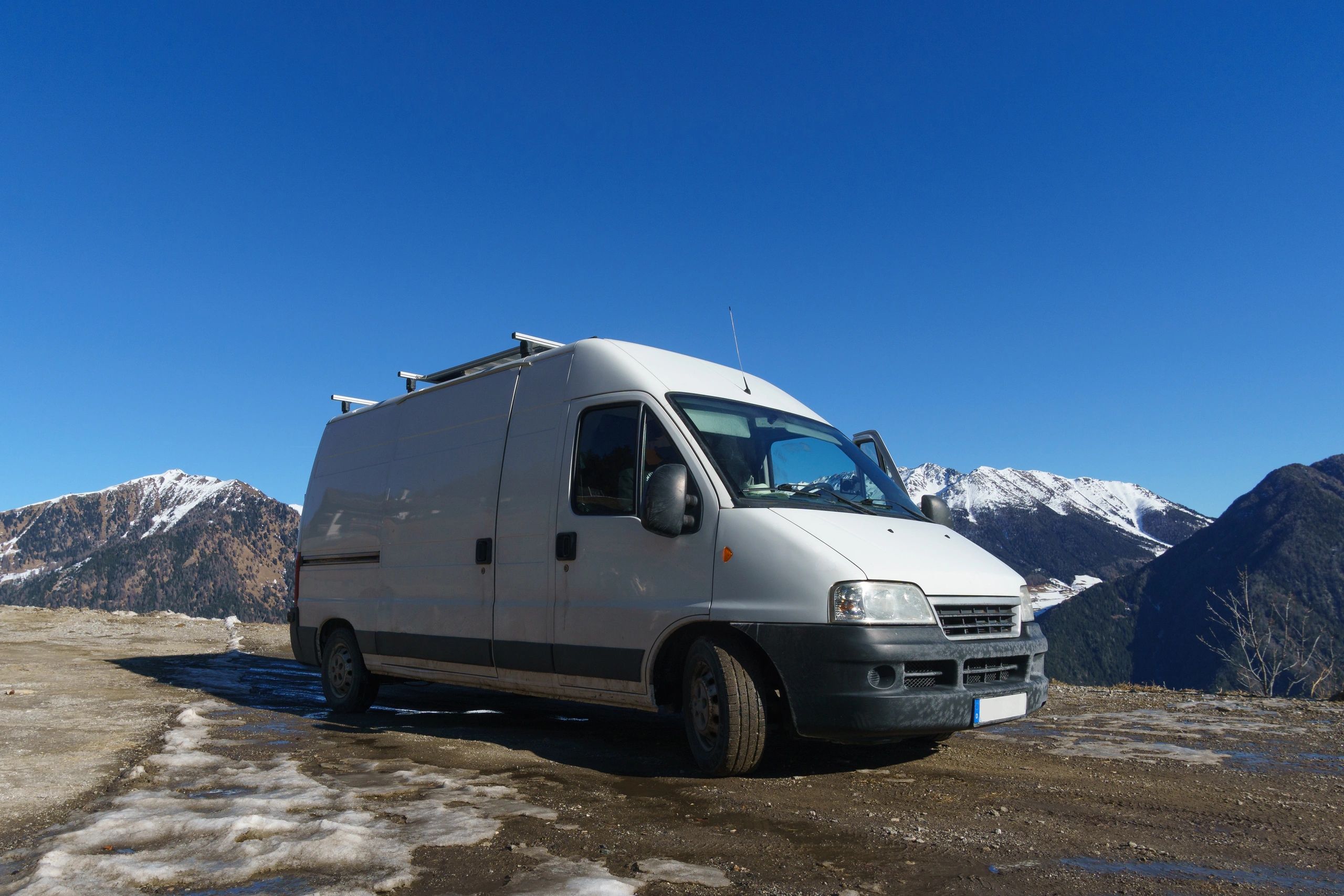
Our new scenario follows a Class B camper van conversion that was built for four-season touring and re-glazed for it. The owner had done everything else right: insulated walls, a properly sized heater, a ventilation fan. But the factory windows stayed single-pane, and in cold weather they were the weakest surface in the build. The full walkthrough is now live in our camper van re-glaze scenario; this post explains why the project matters and what the numbers show.
Why camper vans are the hardest small space to keep clear
A camper van in winter is a condensation machine. Two people cooking, sleeping, and breathing in a few cubic metres of insulated box push the indoor dew point high, and every surface that runs below that dew point collects water. In most builds the windows are exactly those surfaces: single-pane factory glass, chilled by the road on its far side, runs its cabin-side surface far below dew point — so every winter morning starts with wiped windows, wet bedding near the glass, and a damp microclimate the ventilation fan can never quite clear.
The surface-temperature mechanics are the same ones we work through in our window condensation guide: glass fogs where its surface falls below the dew point of the air around it. What makes a van different is scale. A house spreads the moisture load across a large volume of air; a van concentrates it into a space the size of a closet, against glazing chilled by 60 mph of winter road.
The constraint that rules out the obvious fix
The obvious upgrade — triple glazing — does not fit an RV. Wall openings in a camper van are shallow: thin extruded frames set into sandwich-panel walls, dimensioned around the single-pane glass the manufacturer fitted. A triple-glazed unit built for comparable thermal performance measures 28 mm or more and simply has nowhere to go without cutting walls.
Weight is the second constraint. In a vehicle, glass added above the axle is paid for out of payload. A triple build carries roughly twice the glass mass of the vacuum alternative for comparable performance — mass that competes with water, gear, and batteries in a fixed payload budget.
What went into the van
The factory openings were re-glazed with 6.3 mm standalone vacuum insulated glass — two 3 mm lites around a hairline evacuated gap, at roughly 15 kg per square metre. Because the glass-frit edge seal is fused and flush and the unit is portless, the unit's overall depth equals the glass stack itself: it sits in the same shallow rebate the single-pane factory glass occupied, with no frame surgery and no wall rebuild.
The makeup carries a high-performance low-e stack, and center-of-glass performance is calculated, not laboratory-measured: 0.46 W/m²·K on the standard build (integral low-E included), lower with an added coating stack, on the EN 673 / ISO 10292 calculation basis used across this site. Configure your own openings — sizes, coatings, environment — in the RV configurator to see the same physics applied to your build.
With almost no gas in the cavity to carry heat across, the inner lite tracks cabin temperature instead of road temperature. In a small, humid cabin that margin is the difference between condensation and clear glass — and the heater cycles less, because the glass stops being a permanent cold sink at every window.
Where the heat you pay for goes
In a stationary van, cabin heat comes from propane or a 12-volt diesel-style heater, and the energy budget is closed: a house battery bank with hard limits, a fuel tank with a fixed capacity, and no shore power on a boondock night. Conduction through the glazing is often the single largest hole in an otherwise well-insulated envelope — wall and floor insulation is straightforward to build up, but a window is a window, and its area is fixed by the openings the manufacturer chose.
That is why glazing upgrades compound in small vehicles in a way they do not in houses. Cutting the conductive term at the glass directly extends runtime on the same battery and fuel budget — the modeled heat-loss outcome in the scenario frames exactly that term. It is also why the surface-temperature result matters beyond comfort: warm glass is dry glass, and dry glass means the ventilation strategy stops fighting condensation and starts managing fresh air alone.
The outcomes, and what they mean for your build
The scenario reports four modeled outcome cards:
- Glazing depth — 6.3 mm. The flush, portless frit seal fits the shallow wall openings triple glazing cannot, retrofitting into factory rebates with no frame surgery.
- Glass mass — roughly 15 kg/m². About half the mass of a triple-glazed unit built for comparable thermal performance; payload stays with water and gear.
- Inner surface temperature — roughly 63 °F at the 70 °F / 0 °F design condition. Above the dew point of a small, high-humidity cabin, where the fog cycle used to start before sunrise.
- Cabin heat loss — the glazing conduction term cut. Every watt no longer conducted out through the glass is a watt the house batteries and heater do not have to replace.
As with every study on this site, the figures are modeled outputs calculated from published methodology — not laboratory or field measurements. The scenario labels each card accordingly.
Read the full study
The complete walkthrough — problem, solution, outcomes, and the specification notes behind each figure — is live now: camper van re-glaze, four-season build. When you are ready to size your own openings, the RV configurator applies the same calculation basis to your van.
Keep reading
For the wider category, see why vacuum glass belongs in RV windows and the RV scenario with modeled heating-fuel and HVAC outcomes.
The category overview is RV and motorhome glazing.