Our first comparison of vacuum insulated glass against triple glazing covered the spec sheet: center-of-glass U-values, unit depth, and weight. This post finishes the job. It runs both glazing paths through the THERMGLASS ROI engine at its exact default inputs, and it covers the two factors a spec sheet tends to skip — how the technologies compare on sound, and how they compare on the winter morning when condensation decides whether you can see through the glass at all.
Same rules as the first comparison: every figure below is either published THERMGLASS methodology or standard glazing physics, with the calculation-versus-certification caveats stated plainly.
Thermal: what the engine's own baseline table says
The ROI engine ships with a whole-window baseline table, and triple glazing is one of its built-in options: 0.20 Btu/h·ft²·°F in the US model (about 1.14 W/m²·K) and 0.80 W/m²·K in the EU model — two separate regional engine defaults, each representing a triple-pane unit with low-e coatings; the EU default is the more demanding baseline, so the vacuum build's whole-window edge is much narrower there. THERMGLASS standalone VIG enters the same table at 0.13 Btu/h·ft²·°F (US) and 0.73 W/m²·K (EU) — pre-certification estimates pending NFRC 100/500 and EN 673 type-approval testing.
Read as whole-window numbers, the gap depends on the market: in the US the vacuum build sits about 35 percent below the triple baseline (0.13 versus 0.20 Btu/h·ft²·°F — a 0.40 W/m²·K gap), while the EU's more demanding 0.80 W/m²·K default leaves about 9 percent (a 0.07 W/m²·K gap). At center-of-glass level the ordering is starker — a mainstream triple sits around 0.5 to 0.7 W/m²·K COG, while the vacuum build's standard 0.46 already sits at the bottom of that band and the hybrid VIG-plus-cavity assembly reaches 0.25. But whole-window is what an energy model sees, and there the two technologies are closer than the marketing on either side likes to admit.
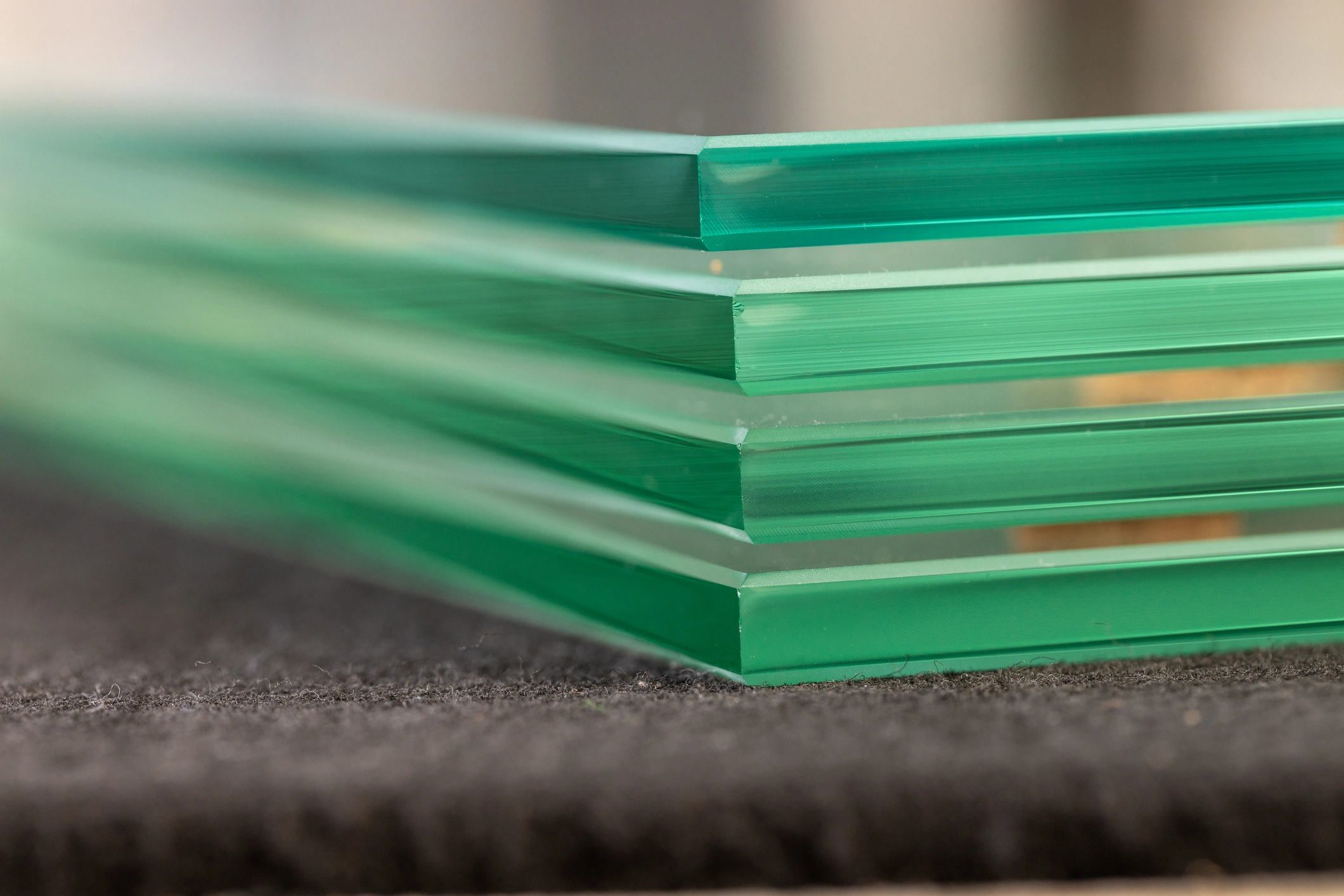
The real difference is what it takes to get there: a triple unit buys its performance with roughly 28 to 44 mm of depth and about twice the glass mass. That package drives everything else in this comparison.
Thickness and weight, briefly
The package facts, compressed from the first comparison: standalone vacuum units build in 6.3, 8.3, or 10.3 mm with the frit edge seal flush, so overall depth equals the glass stack — against roughly 28 to 44 mm for a triple unit with two gas cavities. On weight, glass runs about 2.5 kg per square meter per millimeter, so a 6.3 mm vacuum unit carries roughly 16 kg/m² where a triple with three 4 mm lites carries about 30 kg/m² before spacer and sealant.
Those two lines decide frame compatibility. The vacuum unit fits rebates cut for single-pane heritage glass; the triple unit needs sashes and frames designed around its depth and mass. Where depth allows 20 to 26 mm, the hybrid build pairs the vacuum pane with a conventional cavity for center-of-glass performance beyond either standalone technology.
Sound: the honest scorecard
Acoustic data first, with the caveat attached: THERMGLASS publishes Rw 36–40 dB for standalone vacuum units, rising to Rw 42 dB for laminated or hybrid builds — calculated values per EN ISO 717-1, not laboratory test data.
Triple glazing's acoustic story is about mass and asymmetry. A symmetric triple — three equal lites, equal cavities — typically lands in the high 30s for Rw: better than an ordinary double unit, but the matched resonances between identical lites and cavities cap how far it goes. Asymmetric builds, with lites of different thicknesses, push into the low 40s. Those are technology ranges, not certified figures — exactly why the comparison should be made configuration by configuration.
Read against the vacuum numbers, three conclusions hold. A standalone vacuum unit in the Rw 36–40 dB band sits at the bottom of the triple range — quieter than a basic double unit, but not the reason to choose it. A laminated or hybrid vacuum build at Rw 42 dB matches the top of what asymmetric triples achieve, in a fraction of the depth. And where noise control is the primary requirement — mechanical rooms, flight paths, busy streets — the laminated vacuum build earns its keep on both counts at once: acoustic performance and slim depth, which a triple build cannot offer in the same package.
Condensation: the margin that decides winter mornings
Condensation is a surface-temperature problem, and the inner-surface math from our condensation explainer gives both technologies a number. At 70°F indoors and 0°F outdoors — a real northern-US design condition — the inner surface lands at approximately 60°F on a triple pane (whole-window U ≈ 0.20) and about 63°F on vacuum insulated glass (U ≈ 0.13). Against a 70°F room at 50% relative humidity, where the dew point sits near 50°F, both technologies keep the center of the glass comfortably dry; the vacuum build simply carries a few degrees more margin.
The gap that matters more is in the frame and the retrofit. A triple unit's depth forces either new sashes or — in retrofit — secondary-framing approaches that can leave a cold, poorly ventilated cavity around the glass, a condensation-prone pocket the first winter will find. A 6.3 mm vacuum unit drops into the original rebate with the original ventilation path intact. Same physics, different failure mode: the triple's condensation risk migrates to the installation detail; the vacuum unit's is governed by the glass itself.
Cost and payback: the engine's numbers
Start with the scenarios where the payback runs shortest, because those are the ones most projects actually face. Priced against the engine's default baseline — a double-pane low-e whole-window at 0.45 Btu/h·ft²·°F, what most North American buildings already have — the same engine returns about $643 a year and a 14.0-year payback. Set the baseline to the single-pane glazing still common in older openings (1.10 Btu/h·ft²·°F) and the same run returns about $1,612 a year and a 5.6-year payback: the comparison that actually sells vacuum glass, and the reason most retrofit projects should price VIG against the glazing they have, not the glazing they might have bought instead. Expensive energy moves the number the same direction — the EU engine's defaults, with higher tariffs and a real cooling season, return about €802 a year and an 11.2-year payback on the same 50 m² at €180 per m² — and every dollar taken off the installed cost shortens it again: halve the cost and the payback exactly halves.
Then the stress test, because it should be uncomfortable. The ROI engine prices any upgrade against the baseline you give it, so set the baseline to triple glazing and run the engine at its exact defaults: 500 ft² (US) or 50 m² (EU), IECC zone 6 or central-EU climate, gas heat, the published installed-cost figure ($18/ft², €180/m² — the full installed cost of the vacuum units), a 5% discount rate, 2.5% energy escalation, and a 25-year horizon.
In the EU model, replacing a triple-pane baseline with VIG saves about €514 a year on that 50 m² — 2,025 kWh of annual heating-and-cooling energy, most of it cooling now that the model prices the cooling season properly. At the full installed-cost figure — €9,000 across 50 m² — simple payback is roughly 17.5 years, and the 25-year net present value is still positive, at about +€300.
One clarification before comparing the two rows: the engines' triple baselines are not the same pane. The US engine's triple default is 0.20 Btu/h·ft²·°F — about 1.14 W/m²·K — while the EU engine's is 0.80 W/m²·K, a materially better unit. Each payback figure is measured against its own regional triple, so the 17.5- and 33.3-year numbers are not directly comparable.
The US model is less kind. Replacing a triple baseline saves about $270 a year across 500 ft² (3,278 kWh); at the full installed-cost figure of $9,000, payback stretches to roughly 33.3 years and the 25-year NPV is negative, at about −$4,113. One honest framing note: the engine's $18/ft² input is the full installed cost of the vacuum units, not a VIG-over-triple increment — so this run charges the vacuum units' entire price while crediting only the energy saved beyond what triple glazing already saves. That makes 33.3 years the worst-case energy-only reading; a project that would have installed new glazing anyway faces a smaller increment and a shorter payback. But even generously adjusted, the energy-only case for choosing vacuum over triple is thin in the US model.
That is the honest cost verdict: vacuum-over-triple is not primarily an energy purchase. It is an installed-cost purchase — avoided sash and frame work, avoided handling and freight on half the mass, avoided construction in constrained openings — with the energy delta as a modest bonus. In the EU model the energy math carries its own weight; in the US model it rarely does on its own.
The bottom line
On thermal performance, the technologies converge at whole-window level, with vacuum slightly ahead and far ahead at center of glass. On package, vacuum wins outright: one-fifth the depth, half the mass. On sound, the laminated and hybrid vacuum builds match the top of the triple range in a slimmer unit, while standalone vacuum sits at the entry of it. On condensation, both keep dry glass in the model; the vacuum build carries a few degrees more surface-temperature margin and, in retrofit, avoids the installation cavities where condensation actually takes hold. On energy-only payback against a triple baseline, be skeptical — the honest numbers are in this post.
Run both glazing paths against your own building in the architectural ROI calculator, and read the calculation methods behind every figure above in the engineering methodology.
Keep reading
The verdict above is pinned to one set of inputs. The VIG vs triple glazing payback sweep re-runs it across IECC climate zones, four heating fuels, and premium levels — showing exactly where the answer moves. And for the full spec-by-spec breakdown, see the original U-value, weight, and cost comparison.
Application fit is mapped on architectural vacuum glazing.