Demand for high-performance glazing keeps growing as energy codes tighten, carbon rules take effect and building owners look for ways to cut operating costs. Vacuum insulated glass is one of the few products that delivers top thermal performance in a thin, light unit. Yet production capacity is still limited in most regions.
That gap is an opportunity for companies that can make VIG locally.
What the Own Your Factory program offers
Through the Own Your Factory program, THERMGLASS supplies turnkey, intelligent continuous warm-edge VIG production lines: raw glass in one end, finished vacuum insulated glass out the other. This is an advanced continuous (VIG) production line — a portless continuous-process line, not a batch operation — so owners produce under their own brand and serve their own market. Lines are manufactured in China, with turnkey pricing available worldwide.
Who it suits
- Glass fabricators and tempering shops looking for a higher-margin product
- Window and door manufacturers who want to control their glazing supply
- Regional investors who want to serve a country or region that currently relies on imports
- Companies already serving refrigeration, vehicle, RV or marine OEMs
Why make VIG locally
- Shipping: glass is heavy and breakable, so local production cuts freight cost and damage risk
- Lead times: local supply means shorter, more reliable delivery for builders and OEMs
- Margin: VIG is a premium product with fewer competitors than standard IGUs
- Market access: some public and commercial projects favor or require domestic content
- Brand: you sell under your own name in your own market
Line configurations and capacity
Five standard layouts are available, plus custom configurations. Capacities are manufacturer-published, and layout drawings with exact line dimensions are provided on request. Floor-space requirements are matched to your market during project planning.
| Layout | Type | Annual output |
|---|---|---|
| A | Fully automatic | 100,000 m²/yr (≈ 1.08M sq ft) |
| B | Fully automatic | 150,000 m²/yr (≈ 1.6M sq ft) |
| C | Fully automatic | 200,000 m²/yr (≈ 2.15M sq ft) |
| D | Semi-automatic | 80,000 m²/yr (≈ 0.86M sq ft) |
| E | Semi-automatic | 120,000 m²/yr (≈ 1.29M sq ft) |
| F | Semi-automatic | Custom |
Inside the continuous line
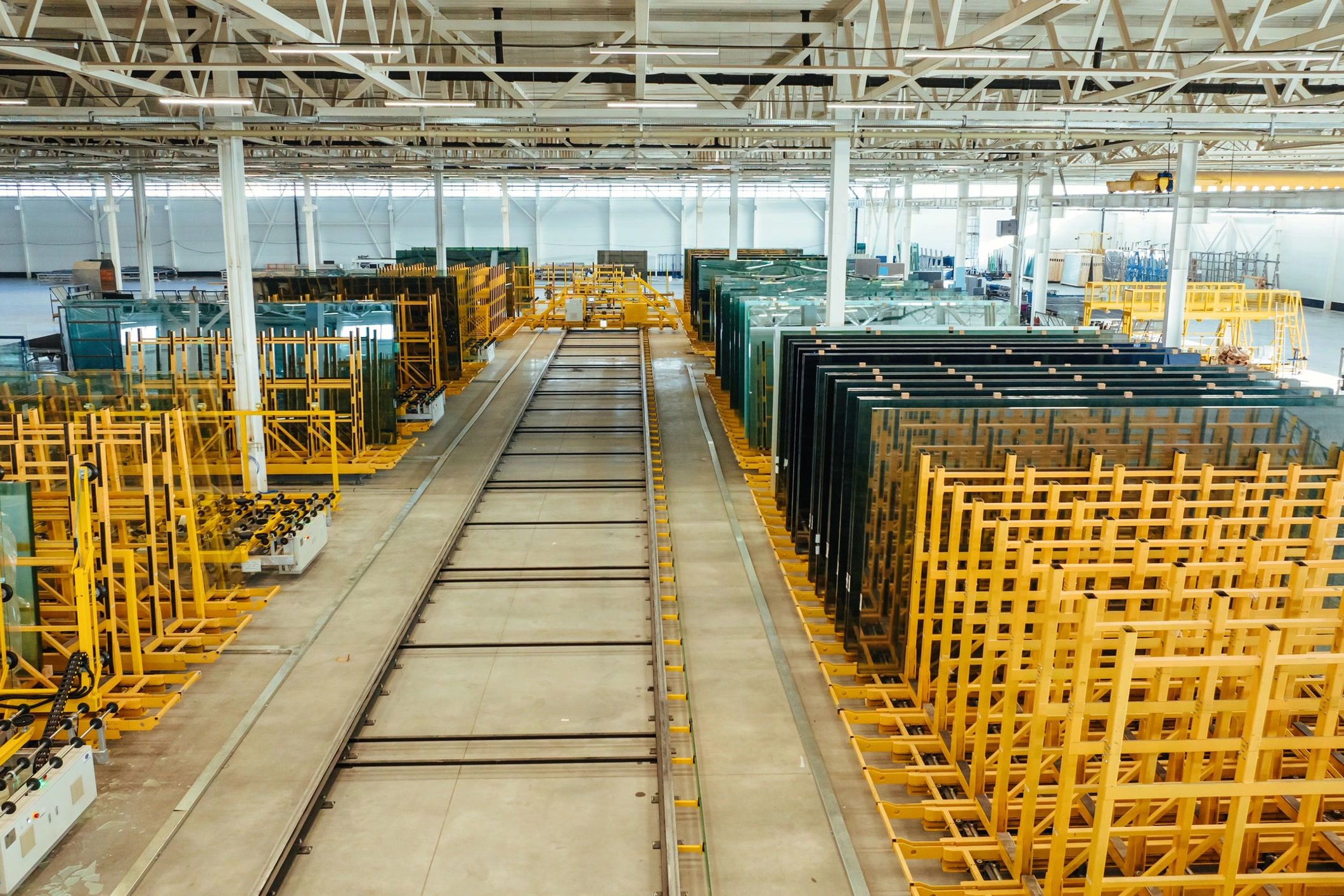
A fully automatic line runs the complete path: raw glass loading and storage, automatic loading, cutting and laser marking, sorting, dual edge grinding, washing, glass placement, tempering, unloading and rotary conveying, a second sort, a second wash, edge pasting, pillar (spacer) placement, curing, inspection and clamping, the continuous vacuum section, then automatic unloading and stacking.
The semi-automatic line starts from pre-cut, tempered glass. It omits cutting, grinding, washing and tempering — the right choice if you already operate a tempering line or buy tempered glass in.
Continuous flow replaces batch processing: full automation with minimal downtime and high yield, uniform heating and fast cooling, a fully automated and traceable system for consistent product quality, and substantially increased output with far fewer operators. Production energy consumption is about one-fifth of traditional batch processes, with significantly reduced labor costs.
The edge seal decides the service life
Every vacuum glazing approach makes a choice at the edge. Metal edge sealing — stainless steel, tin alloy or aluminum — bonds physically only, relies on organic sealants that age, and the metal's high conductivity creates a thermal bridge that leaks heat at the perimeter. Metal and glass also expand at different rates, which can bend the edge and crack the seal over time.
These lines use warm-edge composite sealing instead: a low-melting-point composite, sealed at just above 300 °C, forms a permanent, stable inorganic chemical bond. Its thermal conductivity is low — 0.8 to 1.2 W/(m·K) — and the low sealing temperature does not compromise the strength of tempered glass.
What the finished glass delivers
- No pump-out port or cap — a clean appearance and no potential leak point, made possible by high-vacuum processing
- A low-temperature warm-edge composite seal for energy efficiency and durability
- Continuous-line production for high quality and consistency. Per the manufacturer, a longer continuous vacuum section yields longer VIG service life
Units built on these lines match the published THERMGLASS specification: standalone VIG from 6.3 mm with a center-of-glass U-value of 0.46 W/(m²·K) and hybrid builds at 0.25 W/(m²·K), a vacuum gap of roughly 0.3 mm held below 0.1 Pa, and a micro-pillar support grid across the vacuum gap. Standalone builds run 6.3, 8.3 or 10.3 mm; hybrid assemblies run 20.3 to 26 mm. The U-values are calculation-derived under EN 673 / ISO 10292 — NFRC 100/500 and EN 673 certification testing is in progress — and ISO 19916-1 is the governing product standard for VIG.
What's included
The turnkey package covers the complete path from raw glass to finished VIG:
- The full production equipment set for the continuous VIG production line, configured for your market and output goals
- On-site installation and commissioning of the line
- Operator and quality-control training for your team
- Process technology transfer, so your staff can run and sustain production under your own brand
- Ongoing technical support from THERMGLASS after start-up
Questions to answer before you invest
- Market: who are your first customers, and what volume can they commit to?
- Site: floor space, power supply, ventilation and access for glass delivery
- People: operators, quality control and maintenance staff, and the training they need
- Certification: which product standards your markets require
- Financing: equipment, working capital and the time it takes production to ramp up
Next step
Tell us about your market and your plans, and we will walk you through line options, layout drawings and the business case.
Explore the opportunity on the Own Your Factory page, or send us a message for turnkey pricing, layout drawings and factory visits.
Keep reading
Before committing capital to a line, know the product cold: how vacuum insulated glass is made and specified and what drives vacuum glass payback for end customers. The full program overview is on the Own Your Factory landing page.