
THERM GLASS GROUP LLC — Equipment Sales
Own Your Factory
Turnkey intelligent continuous warm-edge vacuum insulated glass (VIG) production lines — from raw glass in to finished VIG out. Manufactured in China. Turnkey pricing available worldwide.
- m² of finished VIG per year
- 80,000–200,000m² of finished VIG per year
- the energy use of traditional batch processes
- ≈ 1/5the energy use of traditional batch processes
- center-of-glass U-value achievable with vacuum insulated glass (standalone; hybrid 0.25)
- 0.46 W/(m²·K)center-of-glass U-value achievable with vacuum insulated glass (standalone; hybrid 0.25)
The product
Why Vacuum Insulated Glass
A vacuum layer between two lites of glass nearly eliminates gas conduction and convection — the two main paths of heat loss in conventional insulating glass. VIG is a key material for passive-house and zero-energy buildings.
Ultra-low U-value
Center-of-glass U-value of 0.46 W/(m²·K) standalone; 0.25 W/(m²·K) in hybrid builds.
No gas convection
The vacuum eliminates convective heat transfer between lites.
Anti-condensation
Inner surface stays above dew point in cold, humid conditions — preventing fogging and condensation for clear, unobstructed vision.
Passive & zero-energy ready
Built for the most demanding energy codes and high-performance building programs.
The technology decision
Edge Sealing: Warm Edge vs. Cold Edge
The edge seal determines how long a vacuum unit keeps its vacuum — and how much heat leaks around the perimeter. These lines use warm edge composite sealing.
Warm Edge — Composite Sealing (this line)
- Low-melting-point composite, sealed at just above 300 °C
- Forms a permanent, stable inorganic chemical bond
- Low thermal conductivity: 0.8–1.2 W/(m·K)
- Low sealing temperature does not compromise tempered glass strength
Cold Edge — Metal Sealing
- Stainless steel, tin alloy or aluminum frames
- Physical bonding only; organic sealants are prone to aging
- High metal conductivity creates a thermal bridge and heat loss
- Metal/glass expansion mismatch can bend the edge, crack the seal and cause failure
The equipment
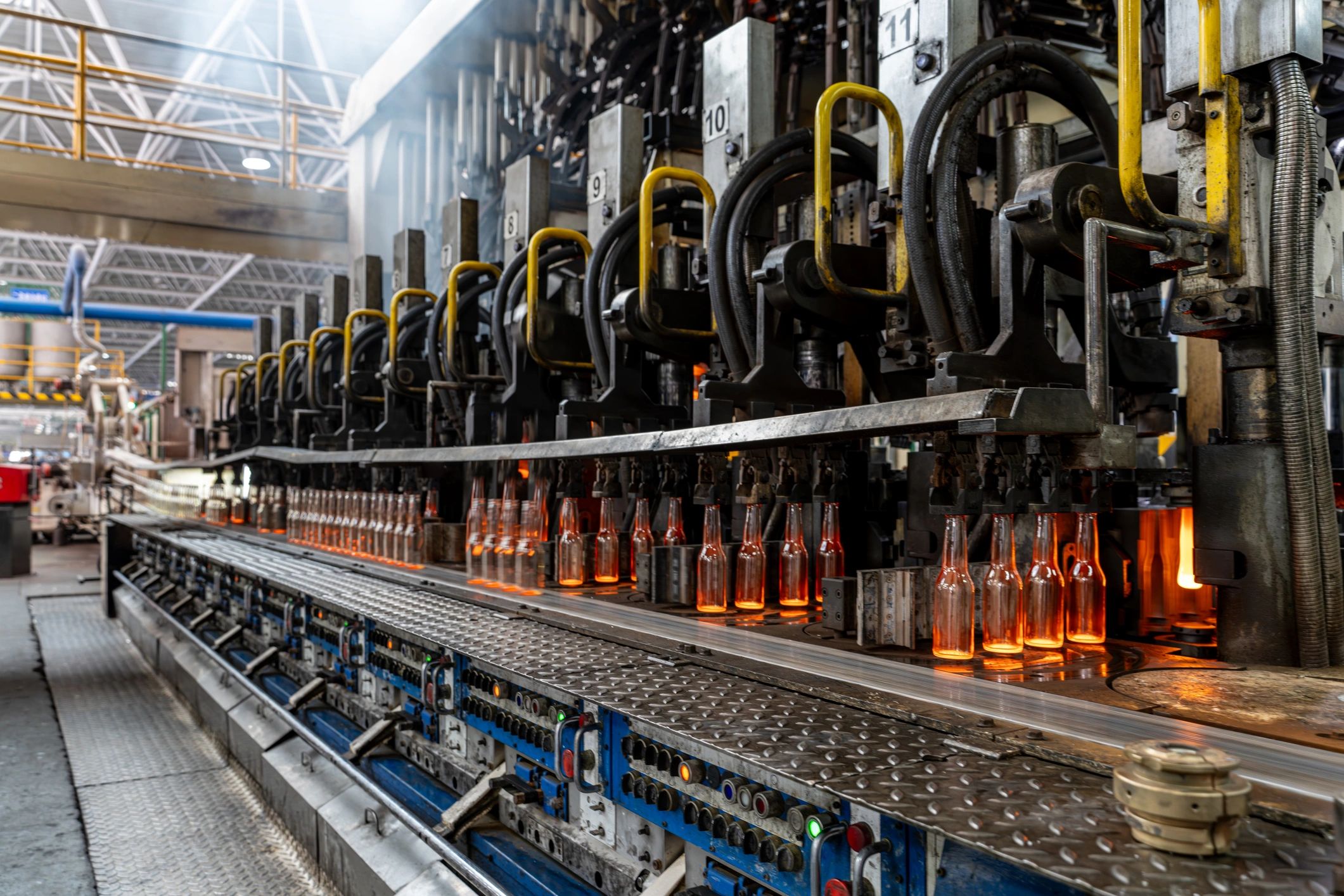
The Intelligent Continuous Production Line
Continuous, automated flow replaces batch processing — raising output while cutting energy and labor.

Unmatched efficiency
Full automation and continuous flow with minimal downtime, high yield and fast cooling.
≈1/5 the energy use
Production energy consumption is about one-fifth of traditional processes, with significantly reduced labor costs.
Consistent quality
Uniform heating, advanced sealing and a fully automated, traceable system ensure uniform product quality.
Higher output, smaller crew
Substantially increased output with far fewer operators than batch production.
Finished glass
What the finished glass delivers
Non-invasive design
No pump-out port or cap — a clean appearance and no potential leak point, made possible by high-vacuum processing.
Superior sealing
Low-temperature warm edge composite seal, maximizing energy efficiency and durability.
Advanced manufacturing
Made on a continuous line for high quality and consistency. Per the manufacturer, a longer continuous vacuum section yields longer VIG service life.
Inside the line
Production Process
Two line types share the same continuous vacuum core. The semi-automatic line omits cutting, grinding, washing and tempering — ideal if you already operate a tempering line or buy tempered glass.
Fully Automatic Line — raw glass to finished VIG
- 1Raw glass loading & storage
- 2Auto loader
- 3Cutting & laser marking
- 4Sorting
- 5Dual edge grinding
- 6Washing
- 7Glass placement
- 8Tempering furnace
- 9Unloading & rotary conveyor
- 10Sorting
- 11Second washing
- 12Edge pasting
- 13Pillar (spacer) placement
- 14Curing line
- 15Inspection & clamping
- 16Continuous vacuum line
- 17Auto unloading & stacking
- 18Finished warm edge VIG
Semi-Automatic Line — starts from pre-cut, tempered glass
- 1Glass loading area
- 2Edge pasting
- 3Pillar (spacer) placement
- 4Curing line
- 5Sorting
- 6Inspection & clamping
- 7Continuous vacuum line
- 8Stacking & delivery
- 9Finished warm edge VIG
Footprint & capacity
Line Configurations & Layouts
Five standard layouts; custom configurations available.
| Layout | Annual output |
|---|---|
| A — Fully automatic | 100,000 m²/yr (≈ 1.08M sq ft) |
| B — Fully automatic | 150,000 m²/yr (≈ 1.6M sq ft) |
| C — Fully automatic | 200,000 m²/yr (≈ 2.15M sq ft) |
| D — Semi-automatic | 80,000 m²/yr (≈ 0.86M sq ft) |
| E — Semi-automatic | 120,000 m²/yr (≈ 1.29M sq ft) |
| F — Semi-automatic | Custom |
Capacities are manufacturer-published. Layout drawings with exact line dimensions are provided on request.
Next step
Request Turnkey Pricing & Information
Tell us what you're planning. We'll respond with pricing, layout drawings and next steps.